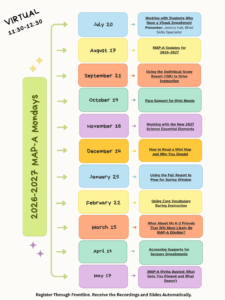
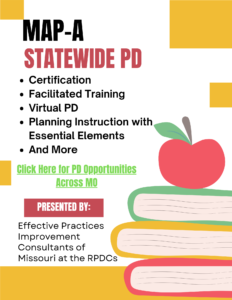
Missouri’s Regional Professional Development Centers (RPDCs) Effective Practice Improvement Consultants (EPICs) from across the state proudly bring schools the MAP-A Monday series. Each month, from July through May, the team hosts a one-hour virtual workshop focused on a key MAP-A topic or strategies for supporting students with significant needs.
We invite you to explore the library below, where you’ll find session recordings, presentation slides, and helpful handouts designed to support your continued learning and classroom practice.
Wondering how IEP teams determine eligibility for MAP-A and what steps guide the decision-making process? Curious how IEP goals differ for students who participate in MAP-A and how to write strong SMART goals with meaningful benchmarks and objectives? We also explore whether students who take MAP-A participate in other state or district assessments. Join us as we clarify these important questions and provide practical guidance to support your work.
- MAP-A Eligibility: recording resources slides
- Eligibility & Pervasive Supports: recording slides handouts
- Essential Elements to Create Goals with Benchmarks and Objectives: recording slides
The sessions under MAP-A Reports review the available reports for the MAP-A assessment and explain how educators can access and effectively use the Fall Progress Report. The series outlines when the Individual Score Report is released and shows how educators can use it to inform instructional and program planning, as well as support IEP development. In addition, this section provides MAP-A District Test Coordinators (MDTC) with guidance on which reports to review, when to review them, and which key indicators and trends to analyze to support data-informed decision-making.
- Fall Progress Reports & Data Extracts: recording slides
- Spring Reports & Parent Contact: recording slides
- Using Individual Score Reports to Plan Instruction and Develop IEPs: recording slides
- Using the Individual Score Report (ISR) to Drive Instruction: recording slides
To ensure educators feel confident and prepared, this section highlights what high-quality instruction looks like for students participating in the MAP-A assessment. Topics will clarify the ELA, Math, and Science standards assessed through MAP-A, explain how the Essential Elements guide aligned instructional planning, and define what engagement activities are and how to implement them with fidelity.
- Engagement in ELA: recording slides
- Planning Instruction with Essential Elements: recording slides blank lesson plan template example lesson plan
- Assessing Writing with MAPA: recording slides
- What Engagement Looks Like for Math, Science, and ELA: recording slides
- Working with Students Who Have a Visual Impairment: recording slides
MAP-A Essentials is designed to go beyond the basics of annual training and strengthen your confidence in administering the MAP-A. Unpack what “instructionally embedded” truly means, clarify how MAP-A differs from MAP and End-of-Course (EOC) assessments, and outline the key responsibilities of District Test Coordinators (DTCs), MAP-A District Test Coordinators (MDTCs), and teachers during each testing window to ensure accurate eligibility decisions, prepare students with high-quality instruction, and assess with fidelity.
- What I Wish I Knew (about MAPA): recording slides handouts
- Teach then Test: What Instructionally Embedded Means: recording slides
- What’s the Difference: MAP, EOC, and MAP-A?: recording slides
- MAP-A District Test Coordinator: What Should be in the District’s Testing Plan? (recording slides)
Support students with significant cognitive needs with these instructional and assessment resources. These tools enhance teaching and testing practices, as well as transition assessment resources designed to strengthen postsecondary planning for students who participate in the MAP-A assessment.
- DLM Resources & Reminders: recording slides
- Strategies for Students with Severe Cognitive Disabilities: recording slides
- Connecting Life Skills Functional Classroom Practices to Post Secondary Transition Assessment: recordings- Part 1 & Part 2 slides
- ELL and MAP-A: recording slides resources
Frequently asked questions received by the Department of Assessment and Effective Practice Improvement Consultants.
- MAPA Questions & Answers: recording slides
- Caryn’s Corner: MAP-A Frequent Concerns & Misconceptions: recording slides
- MAP-A 2026-2027 Updates: recording slides
Register for future MAP-A Monday Series on Frontline!